
Significant Buildings
Rymans, Apuldram
This medieval manor takes its name from William Ryman, a distinguished lawyer who acquired the freehold in 1410 and constructed its earliest sections - a three‑storey stone tower and a two‑storey south wing - which together form the historic core of the T‑shaped house that exists today.
In 1654, the Ryman family sold the estate to the Smith family of Binderton, who renamed the property Appledram Place. The house later passed by marriage to the Bartellot family in 1730, one of Sussex’s most established landowning families. They remained custodians of the estate until the early 20th century.
Rymans has been thoughtfully extended and adapted by its successive owners. Notably, architect Walter Godfrey added the north service wing in 1913 as part of a sensitive programme of restoration and improvement.

Rymans - Across the box hedge formal garden by Rob Farrow, CC BY-SA 2
Rymans - Across the box hedge formal garden by Rob Farrow, CC BY-SA 2
The Hundred House, Birdham
The Hundred House is a Grade II listed building, originating in the 17th century as a timber‑framed house later clad in painted brick. Surviving early features include its substantial internal timber frame and a wide fireplace with wooden bressummers (substantial beams).
The house was altered in the 19th century, with updated cladding and modified windows, reflecting the changes in rural Victorian architecture. In the mid‑20th century, it was further extended to link the original structure with an 18th‑century rear wing.
Unfortunately, no photos of the house are available. The house currently has a painted brick over timber cladded exterior, a tiled hipped roof with gablets, a tall brick chimney, an irregular four‑window façade, and a canted bay to the north.
More information
Clifford's Cottage, Bracklesham and East Wittering

Rob Farrow / Clifford's Cottage Restaurant, Bracklesham
Rob Farrow / Clifford's Cottage Restaurant, Bracklesham
Clifford’s Cottage is a distinctive 18th‑century thatched building in Bracklesham, originally built as two small shepherds’ cottages with a separate thatched outbuilding for their dogs. Dating from the 1700s, it reflects traditional Sussex agricultural architecture and was granted Grade II listed status in 1986.
A major fire in 2012 caused extensive damage, but the cottage was carefully restored under heritage supervision.
The cottage was gradually adapted for various food establishments, eventually becoming known as Clifford’s Cottage Restaurant.
More information
Bracklesham Bay Tea Rooms | The History of Clifford's Cottage
Manor House, Donnington
The Manor House in Donnington stands on Selsey road, just south of St George’s Church. Dating from 1677, the house is Grade II* listed as an important example of late 17th century domestic architecture in West Sussex.
Built of red brick on stone foundations, the house features a central east‑facing doorway with pilasters, a flat arch and a decorative brick pediment bearing the date 1677. Its original windows, steep tiled roof and a mix of original and later chimney stacks all contribute to its 17th‑century character.
Although the exterior survives largely intact, the interior has been modernised with only a few original ceiling beams remaining. Photos of the interior, exterior and surrounding landscape can be viewed in this old listing:
More information
British History Online | A History of the County of Sussex: Donnington
LSA House, Earnley
House No. 144, was one of the houses built in the 1930s as part of the nationwide Land Settlement Association (LSA) scheme that provided smallholdings and homes for unemployed industrial workers starting new lives in rural market gardening communities.
No. 144 was dismantled in 2017 during redevelopment and placed in storage at the Weald & Downland Living Museum. The house has strong historical links with the museum: it was once lived in by Godfrey Shirt, the LSA Central Services Manager, and LSA lorries helped transport early rescued buildings to the museum site - making its preservation especially meaningful.

LSA House No. 144

Dismantling of the house
LSA House No. 144
The museum has now adopted the Earnley LSA house into its capital development programme, with a site chosen for its future reconstruction and planned opening in 2027 as an education centre devoted to the story of all 20 LSA settlements.
More Information
Sidlesham Parish Council | Land Settlement Association Bulletins by Bill Martin
Weald and Downland Living Museum | Our LSA Building: A Part of Britain's Rural Revolution
The Manor House, Hunston

Manor House Hunston by Roger Pagram, CC BY-SA 2.0
Manor House Hunston by Roger Pagram, CC BY-SA 2.0
The Manor House on Church Lane in Hunston is a Grade II* listed manor dating from the late 17th century, most likely built in the 1670s.
The grand house features malmstone rubble with red‑brick dressings, casement windows and a later 19th‑century gabled porch. It is partly enclosed by a moat fed by a nearby pond.
For centuries, the manor, its outbuildings, St Leodegar’s Church, and the rectory formed almost the whole of Hunston. As the village only expanded significantly in the mid‑20th century, the Manor House remains one of Hunston’s oldest focal points.
The house was purchased from the Church Commissioners in the 1990s and carefully restored using a mixture of traditional and modern techniques.
More Information
Historic England | The Manor House, Church Lane
Itchenor Sailing Club, Itchenor
Itchenor Sailing Club (ISC), based in West Itchenor on Chichester Harbour, is one of Britain’s leading dinghy and keelboat sailing clubs. Founded in 1927, Dr B. S. Mends and four other sailors invited 48 people to join the new club - 39 accepted, and by the first AGM a total of 68 founder members had enrolled. From the outset, the club aimed to encourage amateur sailing in all forms and to promote yacht and boat racing.
In 1931, ISC purchased Mrs Wake’s Cottage for £1,625, establishing the permanent harbour‑side clubhouse, while the Haines family laid and maintained the moorings - a responsibility they have continued ever since.

Charlesdrakew, Public domain, via Wikimedia Commons
Charlesdrakew, Public domain, via Wikimedia Commons
During World War II, the club fell inside a coastal restricted zone and was forced to close abruptly in 1940. Parts of the building were first requisitioned by the Army and later by the Admiralty for D‑Day preparations. ISC reopened after the war, with sailing resuming in 1946.
More Information
Runcton Mill, Mundham

Simon Carey / Old mill, Runcton
Simon Carey / Old mill, Runcton
Runcton Mill is a Grade II‑listed former watermill on Mill Lane in Runcton, part of the parish of North Mundham.
The mill's surviving L-shaped structure includes a two-storey 17th-century north‑west wing with casement windows, and an 18th‑century three-storey south‑east wing, distinguished by its modillion eaves cornice and red brick.
Historically, Runcton Mill served as a corn‑grinding mill, supporting the farming communities of North Mundham and nearby hamlets. It continued operating into the 19th century, before falling out of use as industrial methods advanced. The building was eventually converted into a private residence.
The Pavilion, Selsey
The Selsey Pavilion, built in 1913, is a rare surviving pre‑WWI entertainment venue on Selsey High Street. Designed by London architect Harold Arthur Woodington, its distinctive stucco frontage remains largely unchanged.
The multi‑purpose community hall hosted silent films, concerts, dinners, touring performers, and even functioned as a WWI recruiting centre.
After a major fire in 1926, the Pavilion was swiftly restored and continued to host flower shows, political meetings, dances, and popular touring shows like The Selsey Follies. In the 1930s, playwright R.C. Sherriff oversaw rehearsals of Journey’s End here.

“Pavilion, Selsey” SPP/1/1/170, Selsey Photo Archive

Selsey Hall by Mike Smith, CC BY-SA 2.0 <https://creativecommons.org/licenses/by-sa/2.0>, via Wikimedia Commons
“Pavilion, Selsey” SPP/1/1/170, Selsey Photo Archive
In 2017, the Selsey Pavilion Trust was founded to save the deteriorating building and restore it as a community arts and heritage venue. With national funding support, the Trust acquired the Pavilion in 2024, launching a full restoration programme. Plans include reinstating its roles as a theatre, cinema - including 35mm film projection - and a heritage and arts centre.
More Information
Destination Selsey | The Selsey Pavilion
Heritage Trust Network | Selsey Pavilion's Bright New Future
St Mary's, Sidlesham
Spudgun67, CC0, via Wikimedia Commons
Spudgun67, CC0, via Wikimedia Commons
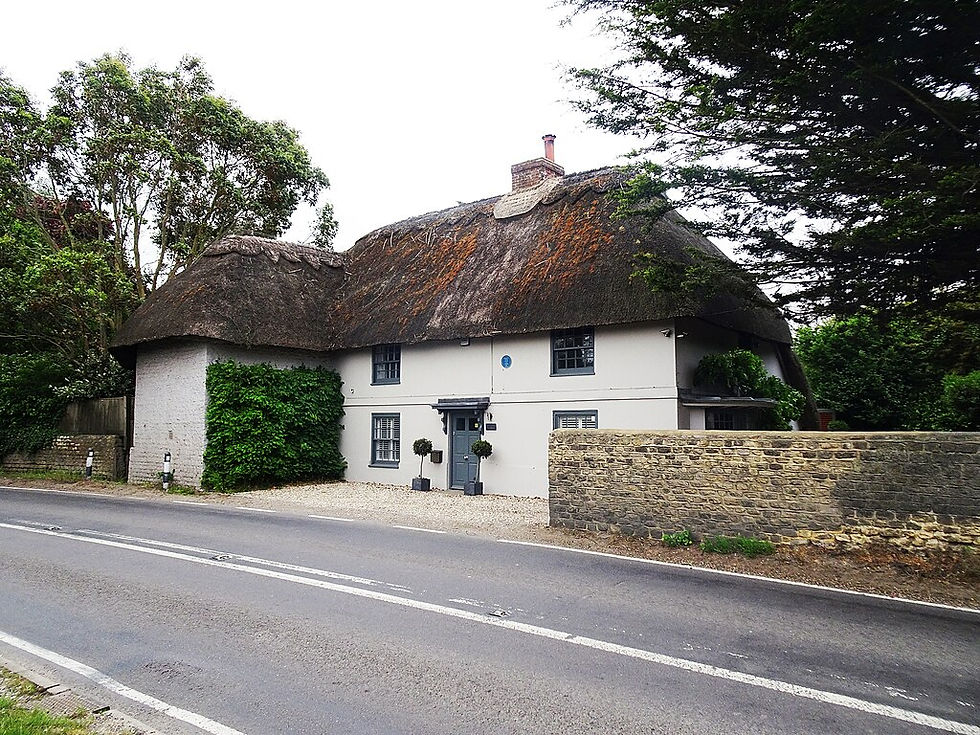
St Mary’s Cottage, a Grade II‑listed building on Selsey Road in Sidlesham, is one of the village’s oldest surviving houses. Originally built as three church alms houses for St Mary Our Lady Church, it was later merged into a single dwelling.
Believed to be of Tudor origin, the cottage likely dates to the 16th century and is the only building in the Parish to display a Blue Plaque to commemorate its early ecclesiastical purpose and continued historical importance.
Elmstead, West Wittering
Elmstead, in West Wittering, is an 18th‑century Grade II‑listed Georgian house distinguished by its symmetrical five‑window façade and Roman‑cement exterior.
From 1917 to 1933, Elmstead was the home of Sir Henry Royce, co‑founder of Rolls‑Royce. Just steps away he established a design studio, now also Grade II‑listed, where engineers worked under his direct supervision. Many major Rolls‑Royce innovations of the 1920s were developed here, and the site’s significance later influenced the choice of nearby Goodwood as the modern Rolls‑Royce headquarters.
Each year on 22 April, the Rolls‑Royce Enthusiasts’ Club holds a commemorative walk from the West Wittering Memorial Hall to the house, retracing Royce’s daily route between his home and design studio.

Elmstead plaque for Sir Henry Royce

Rob Farrow / The Studio, Camacha, West Wittering (Sir Henry Royce)

Peter Facey / The Studio, Camacha Plaque to Sir Henry Royce
Elmstead plaque for Sir Henry Royce