
MWHG Newsletter: 14th September 2026

Dear Volunteers and Supporters,
Since our last update in July, our volunteers have been busy surveying moths and other pollinators, as well as supporting our project leaders at local community engagement events across the peninsula. We also celebrated another anniversary walk along the historic Selsey to Chichester Tramway route. This issue also includes an update from volunteer Charlie, who is doing great work for the West Wittering Tree Nursery Project.
Summer Community Engagement Events
By Emma Horton | Wildlife Warriors

It’s been a long hot summer with special community events across the Manhood Peninsula which Jane Reeve and myself have had the pleasure of attending, along with a number of fantastic volunteers. We are always keen to raise awareness about the important and varied work that the MWHG does. There have been five local events throughout the summer, where we have set up our displays with photos showcasing some of the conservation projects that we get involved with. In addition, we provided a range of free children's wildlife craft activities to engage the youngsters at the events.

It has been well worth participating in these events as we don’t always get the opportunity to spend as much time as we’d like across the whole of the Manhood peninsula. There are 11 different parishes on the peninsula and these events allow us to reach out to inform more people about our work and this sometimes leads to new recruits interested in joining our conservation activities.

Our first event was back on the 7th of June at Southend Farm, which was host to an ‘Open Farm Sunday’. Southend Farm is a 200 hectare estate between the parishes of Donnington and Sidlesham and has been owned by the Fleming family since the 1960s. The farm originally grew crops and had a herd of dairy cows, but in recent years the Flemings have successfully diversified into running ‘Southend Barns Wedding Venue’ by beautifully restoring their old Sussex Barns, creating luxurious buildings, beautifully landscaped with an amazing wildflower meadow. In 2023 the farm converted to a regenerative farming system, with an aim to recover soil health.

The Open Farm Sunday was extremely busy all day with lots of children attending with their grown-ups. We must have made close to 50 dragonfly models with the children, from pipe cleaners, beads and colourful paper wings and they enjoyed flying them around in the grounds. The bug houses were just as popular, especially the tractor themed bug house crafted by Graham! The event was also an opportunity to speak to other stall holders and gain new contacts in the environmental sector.
Mundham Gala and Flower Show took place on Saturday the 4th of July on the North Mundham playing fields. The event was opened by our MP Jess Fuller-Brown and she spent time chatting with us about our charity work. Our stall was located in the ‘Community Corner’, in a marquee with other similar organisations. Our charity’s Chair and Trustee, Dr Lesley Bromley was there to tell people about the ‘Heritage’ side of the organisation as well as her initiative introducing ‘Pollinator Highways’ to the Peninsula.
Many adults took an interest in the displays which document projects that we have undertaken, showing photos of sites ‘before’ and ‘after’ our environmental improvements. One such initiative was our ‘FLOW’ project (Fixing and Linking our Wetlands), when we reclaimed and transformed long forgotten relic ponds from rubbish tips into biodiverse havens.

People are often drawn to our displays because of the animal and habitat photos, as well as the handmade bird and bug boxes on display, made by Graham, for which people are happy to give a donation to the MWHG. Children visited the stand to make their own bug houses to take home, along with other wildlife crafts. Thanks to Angela for helping with the children’s activities throughout the event, along with the rest of the team.
Sidlesham Fete on Saturday the 25th of July was another hot day with families and familiar faces popping along to visit our stand to lend their support. We were glad of the gazebo to keep off the sun and the children’s wildlife crafts proved popular, especially the dragonfly models and the animal masks. There was a choice of animal masks to make, including an owl, a mouse, an adder, a hare, a ladybird and a fox, so there was a favourite animal for everyone. The RSPB were next to us so it was nice to speak to their team about their work on the peninsula. It’s always heartening to meet fellow animal lovers working to safeguard the region’s wildlife and habitats. Thanks to David and Graham for lending a hand with the event.
Selsey Lifeboat Day on Sunday the 2nd of August was a whole day event, with a packed programme of entertainment for the public, both locals and tourists. Our MWHG stall was situated centrally and got increasingly busy in the afternoon, especially as our kid’s activities were free. One parent said it was refreshing to have exciting things for the children to get creative with that didn’t cost anything, compared to the expensive fairground rides. There were lots of other exciting activities going on such as the raft races, the Selsey Shanty Men singing, the RNLI sea rescue demonstrations and more. It was so lovely to see so many MWHG volunteers over the course of the day and we really appreciate the time that David gave to support us that morning.
Our event in Bracklesham took place on Saturday 15th August on a scorching hot day. Thanks to Angela and Graham for their support alongside Jane, putting up gazebos, running wildlife craft activities and clearing away after the event. We are very grateful to all our amazing volunteers who lend their enthusiasm, knowledge, help and time on these community engagement occasions.
Pollinator Highway Project
By Lesley Bromley | Selsey Pollinator Highway Project

We are now looking after 5 different sites in Selsey and one in Sidlesham!
Over the summer we have been surveying the sites and recording the flowers and insects that are visiting. We make a list of all the different flowering plants and grasses on the site. To survey the insects we use a technique called FIT (Flower-Insect-Time) where we mark off a meter square and then watch the area for 10 minutes recording the flowers and any insects within the square. This is a straightforward technique that can be used in your own garden if you would like to start keeping records of the flowers and insects.
We also assess the proportion of grasses to flowering plants in designated areas which we are following year on year to see how the proportions are changing when the land is not mowed over the summer.

The survey information is shared with the Sussex Biodiversity record. The first verge we took over, in Sunnymead drive has a lovely range of flowers in it now!
We survey at the end of June or beginning of July, which was fortunate as the prolonged drought this year has resulted in an early die back of the vegetation. We will be mowing and removing the cuttings in early September this year about a month earlier than in previous years.
We plan to add a second verge in Sidlesham for next year. West Sussex County Council and Sidlesham Parish Council are our partners in this project and we have received support from the Ernest Kleinwort Foundation.
Wittering Area Community Conservation Project
By Jane Reeve | Wittering Area Community Conservation Project
Since the last newsletter in July, we have been focussed on moth trapping. This is a super activity and allows a period of rest from the intense physical activity that takes place in autumn, winter, spring and early summer. We are fortunate to have volunteers and supporters that allow us into their lovely gardens to set up our moth traps and to then host us with an array of cakes and biscuits while we get down to the serious business of identification.
This year we have seen a large number of moths through July, helped by the dry weather but these quantities lessened a little as August progressed, possibly negatively affected by the lack of food available.
We have seen the rise of the Small mottled willow, Spodoptera exigua, a beautifully marked small moth but which we have only previously seen occasionally. This year it has probably been our most common find. It is also known as the Beet armyworm and is known as a serious agricultural pest. It has broad tastes and will eat beets, celery, brassicas, lettuce, tomatoes, cereals and beans and peas. It doesn’t survive the cold so hasn’t been known to overwinter here, preferring warmer climates but this may change. The fact that we have caught so many this year seems to indicate that this insect maybe a problem for our farmers now. This moth can be controlled with pheromone traps and mechanical handpicking of the adults and caterpillars. Biological controls are also successful using specific solitary wasp species, bugs, flies and even ants that feed on the pupa stages.
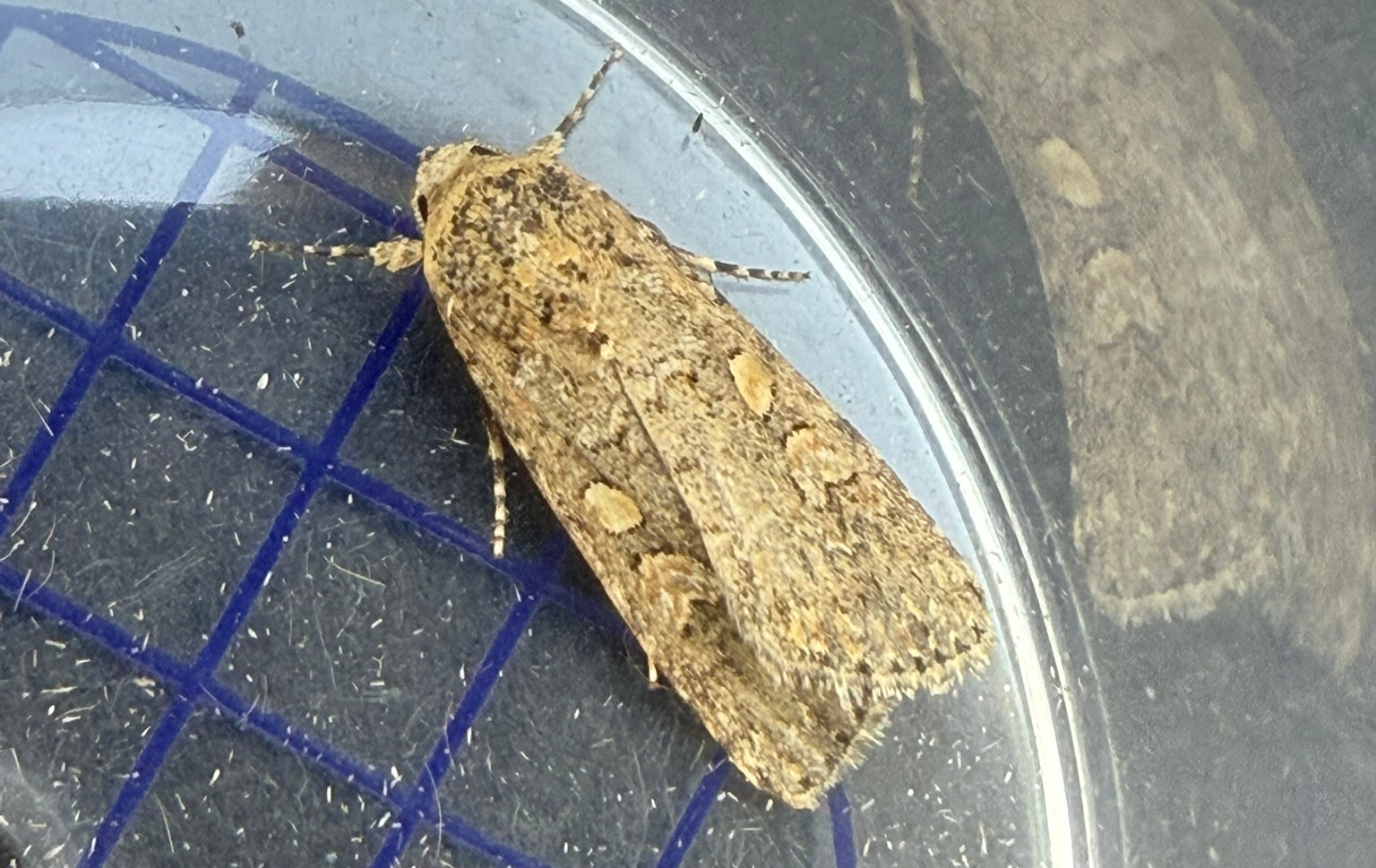
Small mottled willow, Spodoptera exigua, or Beet armyworm
All the data that we gather about the moths we catch goes to the Sussex Biodiversity Records Centre (SxBRC) via iRecord where the information is added to huge body of data that is being added to everyday by groups and individuals that trap moths daily. This can be analysed to look at trends in moth numbers, an often-invisible group of insects, responses to climate change with some species becoming rarer or being pushed north, or new immigrant moths etc. These changing patterns are interesting and can be a guide to insect health nationally. We are playing a very small part in that information gathering process.
Frosted Orange, Gortyna flavago Blood vein, Timandra comae
(L) Frosted Orange, Gortyna flavago, (R) Blood vein, Timandra comae
Copper underwing, Amphipyra pyramidea Dusky Thorn, Ennomos fuscantaria
(L) Copper underwing, Amphipyra pyramidea, (R) Dusky Thorn, Ennomos fuscantaria
One of the best moments is when we first open the trap and peek in to see what we have found. This can involve some jeopardy as we have had a trap full of hornets or wasps in the past, so we are very careful. The hawkmoths are always a winner as they are so big and colourful, but it is often the teeny tiny micro moths that are difficult to identify where the new species are found. We all groan slightly as we take a pot, peer into it and at first think it is empty and then realise the speck of dust is actually a moth! Luckly, Christine, one of our experienced moth peeps is on hand to guide us as and inevitably gets these small creatures to look at. All our results get verified by an expert at the SxBRC so we wait to hear back from him as to whether we got it right. Some moths cannot be identified without dissection, so we do have some that never get named.
Common wasps in the trap European hornets
(L) Common wasps in the trap, (R) European hornets
We all started as newbies to moth identification and at the beginning of our moth trapping season every May we have to kick start the moth memory parts of our brains, open the moth id book at page 1, and try to remember it all again after the seasonal break. It is just repeat repeat repeat that makes it go in but it is worth it. Perhaps next year you will join us 😊.
So how is our Cakeham Cyclepath hedge doing after the relentless hot summer weather? A visit at the end of August showed some really promising results. A walk along the length of the hedge showed green growth on nearly 90% of the newly planted trees. Some were hidden under brambles, hogweed and an invasive gladiolus but they have helped these young trees. The soil at the base has remained cool and protected from winds and it has driven the growth upwards. If deer were to be an issue here, the new trees will have been camouflaged and protected by these other wild plants. The approach of leaving the growth around these trees is being used by Chichester District Council as a case study as we have had such a high rate of survival in a challenging location and summer, with no watering.
Young hawthorn trees on the Cakeham cycle path in August 2026 Wild rose on the Cakeham cycle path in August 2026
(L) Young hawthorn trees on the Cakeham cycle path in August 2026, (R) Wild rose on the Cakeham cycle path in August 2026
This autumn and winter we will be cutting the vegetation around the trees, with a chop and drop approach, using it as mulch at the base so that we lock in that moisture again for the tree roots. We will continue to allow the growth in the summer as we don’t want bramble to completely take over this hedge.
Thanks as ever to all the volunteers and other people that support our work. Big shout out of THANKS to our funders, the Woodger Trust, who allow us to do this important work.
Jane, Project Officer, Community Conservation Project
Heritage News
By Bill Martin | Our Heritage, Selsey Tramway Project, Sidlesham Heritage Project
Land Settlement Association Project
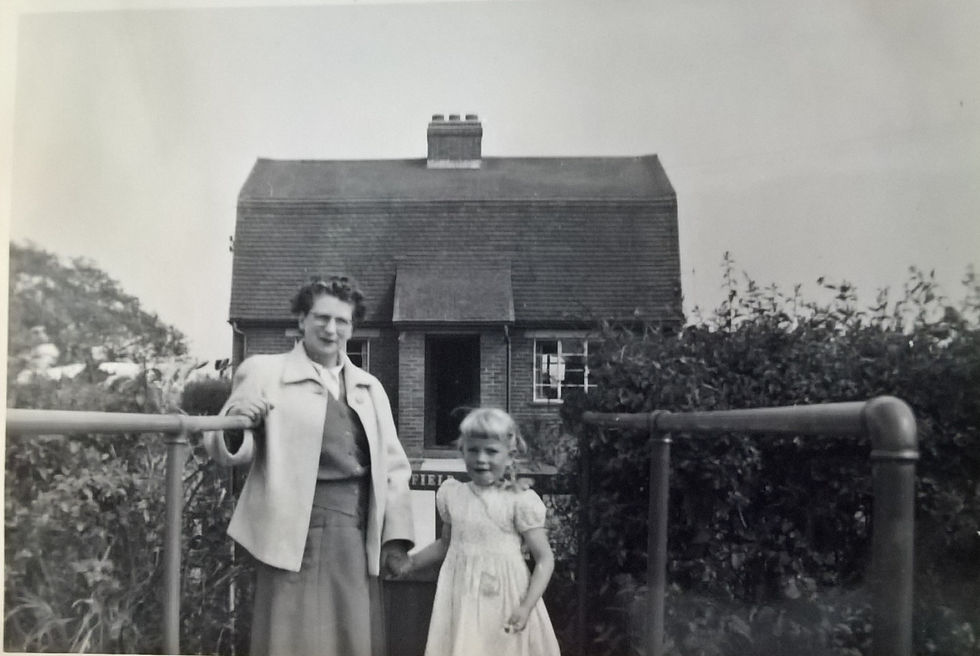
85 people attended an LSA presentation in Sidlesham in June and 25 walked part of the LSA heritage trail in July.
The Weald and Downland Living Museum have an exhibitor's stand at The Goodwood Revival (September 18th-20th) to promote the rebuild of the LSA house.
Selsey Tramway Project
The annual anniversary Tramway walk took place on Sunday 30th August. 15 people followed the route of the tramway from the Chichester Terminus to Hunston Station (see photo below).


Although the Tramway exhibition at the Novium has now finished, our film is still available on YouTube - The Selsey Tramway.
The damaged information boards at Selsey Golf Club and Chichester Terminus have no been replaced.
Landlink, a division of Langmead Farms, had a volunteers day at Chalder Station to clear vegetation and lay more weed control matting (Photo above).
Sidlesham Women's Institute
Sidlesham WI finished in March 2026, 2 years short of it's 100th birthday. A draft of the history of the organisation is awaiting approval by members of their committee prior to publication.
West Wittering Tree Nursery
By Charlie | West Wittering Tree Nursery Project
There is some corner of an allotment field in West Wittering where some years ago MWHG had been allowed space for a tree nursery.
To augment the excitement of bio surveys and moth trapping what could be done to help, being on my doorstep, gaining access with the gate code from my neighbours I went to explore.
Actually "tree nursery" is rather grand, it is three raised beds and a harbour area for potting etc. And a water butt in search of a downpipe and some rain. Obviously well used in the recent past what was found was a bit like one of Jane's rewilding projects. The beds and paths were overgrown with a wonderful variety of wild flowers, and adjacent hedging had encroached. Nettle, bindweed, creeping buttercup and couch grass in abundance. A few nursery saplings and wild roses in between.

Bit by bit over a couple of months the beds have been cleared for use, the paths restored and woodchipped, and accumulated rubbish taken to the tip. Now tidy and ready for use, and hopefully back in the allotment association chairman's good books.
And put to use already, with a batch of oak saplings raised from acorns at home by a local MWHG volunteer, most of which are surviving despite planting out in the record heatwave. Room for more. It doesn't take much to keep things tidy and nursed now we are back in shape. Never really win with bindweed though do you. Enough to keep me busy until the real MWHG hard work resumes this winter.
A bonus was the fruitful discovery of a scrumping orchard in the opposite corner of the allotment field. Sadly in desperate need of expert pruning.
Wildlife Survey Results
By Nikki Timney | Find Wildlife From Home Survey
In July and August, 47 wildlife records, including 52 individuals spotted, were submitted to us by our volunteers and supporters. Our wildlife survey has now received a grand total of 2,104 records - as always, thank you to everyone who takes part!
Take a look at some of the photos and survey results we received since our last update.
Survey Results for July and August
Jersey Tiger Moth by F McStea Holly Blue by F McStea Twenty-Plume Moth by J Shimell Large White by F McStea Blackbird by F McStea 7-spot Ladybird by F McStea
1 7-spot Ladybird | 4 Holly Blue Butterflies | 1 Common Plume Moth |
3 Humming-bird Hawk-moths | 3 Large White Butterflies | 13 Dunnocks |
2 House Sparrows | 1 Twenty-plume Moth | 2 Peacock Butterflies |
Tell us about the wildlife you've seen in your garden, neighbourhood and surrounding local area and we will also submit your records to the National Biological Records Centre on your behalf.
To take part in our wildlife survey, click on the button below.


Comments